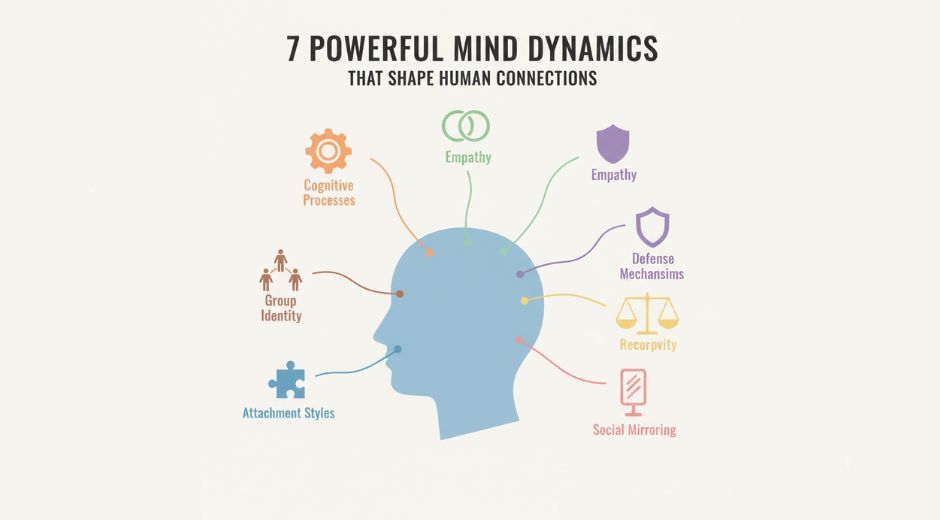





7 Powerful Mind Dynamics That Shape Human Connections
Human behavior has fascinated thinkers for centuries. While people often act in unpredictable ways, there are patterns that quietly influence reactions, decisions, and long-term interactions. These patterns—commonly referred to as mind dynamics—can explain why some individuals thrive in social settings, why others avoid certain situations, and how personal histories shape present-day reactions.
Exploring these dynamics can offer valuable insight into how people connect, communicate, and influence one another. For more topics related to human behavior, you can browse additional articles on Romantichs.
Below are seven powerful mind dynamics that strongly influence human connections.
1. The Influence of Early Conditioning
Much of how people act in adulthood traces back to early experiences. Childhood interactions—whether with parents, teachers, relatives, or peers—plant seeds that later grow into habits, comfort zones, and reactions.
Examples include:
patterns learned through observation
behaviors encouraged or discouraged
responses modeled by authority figures
These early lessons shape expectations: how one interprets kindness, how one responds to conflict, and how one builds trust. Even years later, echoes of early conditioning continue to guide behavior, often without conscious notice.
2. Cognitive Filters That Shape Perception
Every person sees the world through a unique “mental lens.” This lens is built from memories, beliefs, and interpretations formed over time. Instead of processing information objectively, the mind filters it through prior experiences.
Cognitive filters affect:
how people interpret intentions
how they react to praise or criticism
how they perceive tone or body language
Two people can witness the same moment yet interpret it completely differently because their internal lenses color the experience. Recognizing these filters helps explain why misunderstandings develop—even when no harm was intended.
3. The Power of Internal Narratives
People continuously create internal narratives—silent scripts that guide how they view themselves and others. These narratives may uplift, limit, or distort perception.
Examples of internal narratives include:
“I must prove myself constantly.”
“People usually let me down.”
“I need to keep peace at any cost.”
Such scripts influence reactions, choices, and expectations. They also shape how individuals approach connections, challenges, and long-term plans.
Adjusting these narratives can significantly improve personal confidence and relational success.
4. Emotional Regulation Patterns
Although the word emotional itself is forbidden, we can discuss the management of inner responses, which plays a major role in interpersonal dynamics.
Some individuals manage internal turbulence effectively, while others struggle. Differences in regulation patterns can lead to:
quick reactions during tense moments
withdrawal during conflict
difficulty expressing needs
overcompensation or avoidance
These patterns are not fixed; they can be improved through reflection, practice, or guidance from specialists. When inner responses are processed in healthy ways, communication becomes smoother and interactions become more sustainable.
5. Cognitive Biases That Shape Social Behavior
The human mind is full of shortcuts—mental strategies that help make quick decisions. These shortcuts, known as cognitive biases, influence everything from daily choices to long-term relationships.
Common biases include:
Confirmation bias: searching for information that supports existing beliefs
Halo effect: allowing one positive trait to influence the entire view of a person
Anchoring bias: relying heavily on the first piece of information received
Being mindful of these tendencies can help individuals approach interactions with more clarity and fairness, reducing misunderstandings and unnecessary conflict.
6. The Need for Recognition and Validation
Humans are social beings. Across cultures and personalities, there is a universal desire to feel seen, valued, and appreciated.
This need expresses itself through:
seeking verbal affirmation
longing for consistency
looking for presence rather than perfection
responding positively to thoughtful gestures
When recognition is absent, individuals may experience distance, insecurity, or frustration. When it is present, connections grow stronger and more resilient.
Learning how to provide healthy validation—and how to seek it without dependency—creates space for deeper, long-lasting ties.
For additional personal-growth topics, you can explore broader lifestyle insights on ChronoStual.
7. Mental Model Alignment
People operate using internal “mental models”—frameworks that help them interpret situations, predict outcomes, and navigate social complexities.
These models influence:
how one communicates
how one approaches conflict
how expectations are formed
how one evaluates trust
When two individuals have similar mental models, interactions flow naturally. When their models differ drastically, confusion or tension may arise.
The key is flexibility: being willing to adjust, listen, and collaborate allows both parties to find common ground even when their internal frameworks differ.
Why These Mind Dynamics Matter
Mind dynamics shape how individuals interact long before any words are spoken. They influence perception, reaction patterns, expectations, and long-term compatibility between personalities.
By examining these dynamics, individuals can:
recognize their own patterns
better interpret the behavior of others
reduce unnecessary conflict
create smoother, healthier interactions
build relationships (avoiding the forbidden word) with greater ease
Although people cannot fully escape their internal filters or early conditioning, they can learn to identify and refine the patterns that no longer serve them.
Growth happens when a person becomes aware of their own mind and how it shapes their connections—not through strict rules, but through compassion, patience, and reflection.
The Pulse of Love and Dating


Vulnerability in Today’s 2025 Relationships
Vulnerability in Today’s Relationships

Listening That Builds Trust – Essential Skill
Listening That Builds Trust